
Biological activity
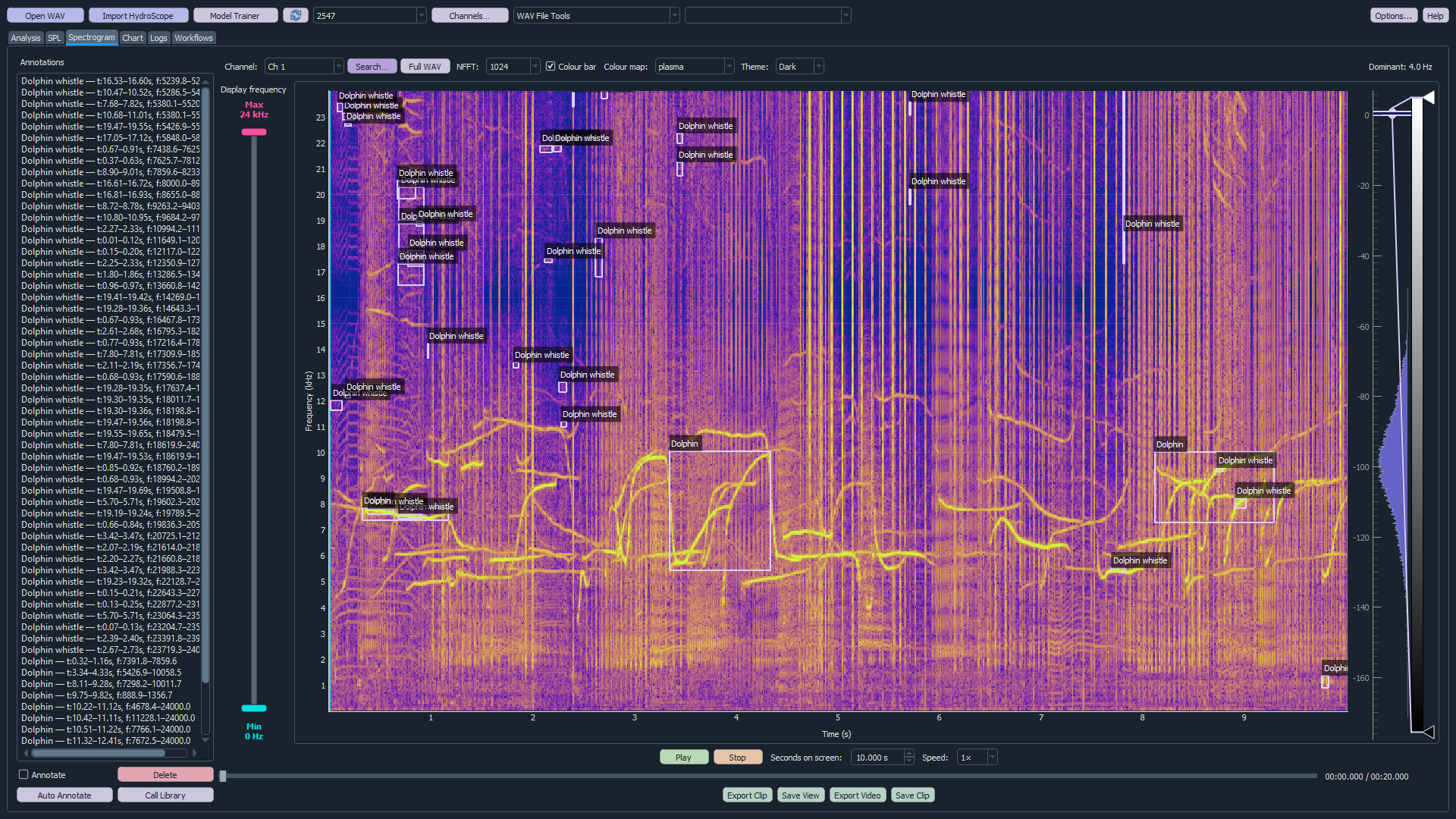
Inspect recurring calls, choruses, clicks and other biological acoustic events.
Biological, environmental and human-made sound
Explore long recordings with spectrogram, calibrated level and detection tools, then relate acoustic patterns to time, position, depth and water-column conditions.
From recordings to patterns
An underwater soundscape can contain biological activity, weather, vessels, machinery and other sources that overlap in time and frequency. Analyze provides complementary views for separating and documenting those patterns.
Navigate waveform, FFT and spectrogram views; listen to selected regions; and compare recurring tonal, broadband and impulsive features.
Use recorder and hydrophone calibration information to interpret SPL and frequency-dependent results where the required metadata is available.
Relate observations to GPS tracks, CTD profiles, deployment depth and propagation scenarios rather than treating each recording as an isolated file.
Soundscape questions
Inspect recurring calls, choruses, clicks and other biological acoustic events.
Compare broadband and tonal vessel sound with time-aligned position or operational records.
Review changes in background level and spectral character across recording periods.
Document continuous machinery sound, construction activity and impulsive events.
Compare acoustic observations with depth, temperature, salinity and propagation conditions.
Save reviewed events, clips, plots, spectrogram views and structured tables for reporting.
A repeatable workflow
Group deployment files, calibration details, positions and environmental data within the project.
Find acoustic features manually or with model assistance, then review and classify the events that support the interpretation.
Retain consistent images, clips, measurements and tables so differences between periods or locations can be reviewed and reported.
Related applications
We can demonstrate a soundscape workflow around the sources, locations and environmental information relevant to your study.